


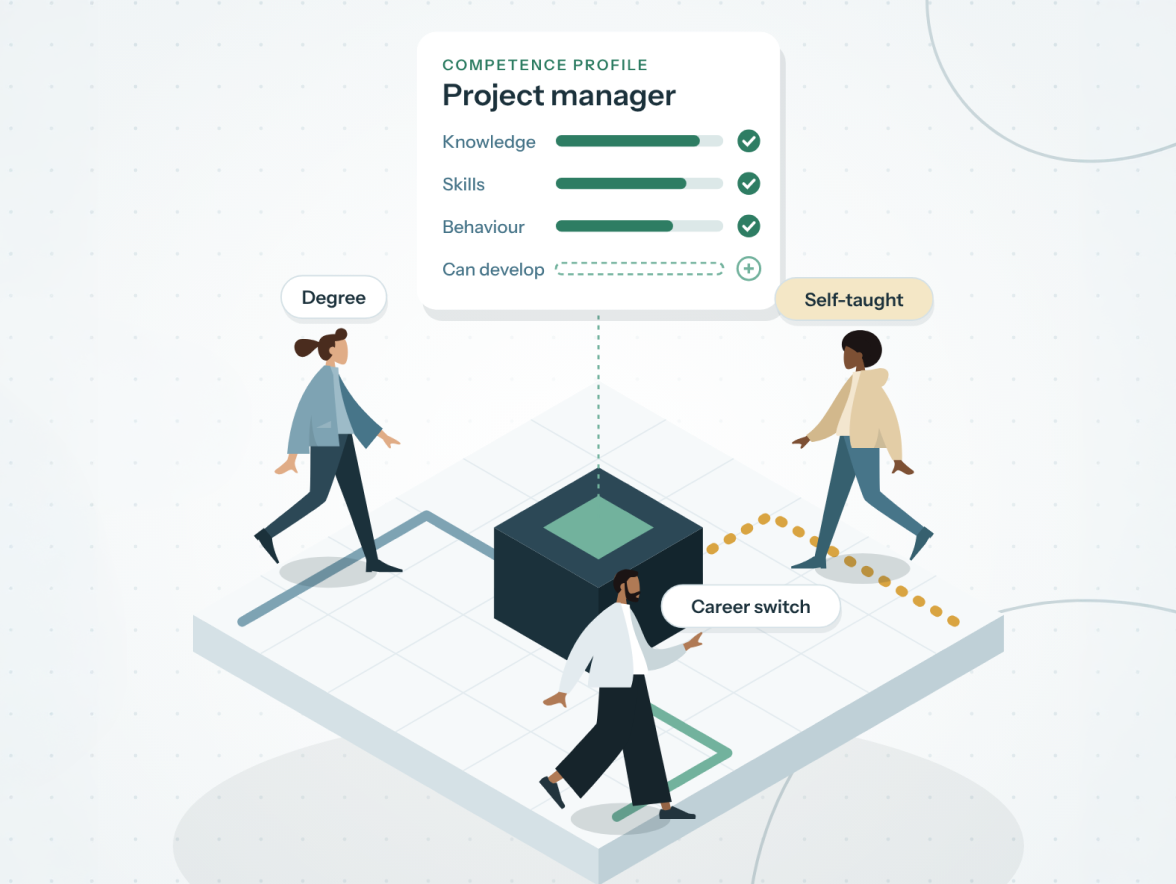
In their careers, people reach the same profession through different routes. Some follow formal education and established careers, while others change direction or learn independently. Each path can build abilities that a CV only partly reveals.
Competency-based hiring gives candidates a chance to demonstrate those abilities against the demands of the role. It also asks employers to be clear about what matters, which skills are essential and what can be learned.
This can change where companies look for talent and whom they consider. Interviews still have a place in this approach, but they are no longer the whole basis for judging a candidate. They become one way to understand whether a person has the capabilities the role requires.
To understand this shift, let’s begin with what competency-based hiring means.
What is competency-based hiring?
Competency-based hiring means selecting people based on the knowledge, skills and behavior needed to do a job well. It focuses on how candidates apply their abilities in situations they would face at work.
For example, a project manager may know how to create a schedule. But when two teams need the same resources, they must also weigh priorities, negotiate deadlines, and explain the decision. Competence involves bringing these abilities together to handle the responsibility.
To assess this, an employer first defines what the role requires and which abilities are essential from the start. Candidates then get opportunities to demonstrate them through practical tasks, project discussions or competency-based interviews about past experiences and realistic scenarios.
The findings help the hiring team decide whether a candidate is ready for the role and where they may need support after joining.
The core principles of competency-based hiring
Competency-based hiring rests on four principles that guide how employers assess and compare candidates.
Define what the job needs
Identify the knowledge, skills and behaviours essential to the role. These should reflect the work the person will actually handle.
Ask for evidence
Give candidates opportunities to show their abilities through relevant tasks, examples of past work and competency-based interviews.
Use consistent standards
Assess candidates for the same role against a shared set of criteria. Agree on what a strong response looks like before assessments begin.
Leave room for development
Separate abilities needed from day one from those that can develop with support. This helps employers recognise potential while setting realistic expectations.
Why the shift in hiring criteria
A career history tells an employer where someone has worked. It takes closer examination to understand what that person can do today.
This distinction matters when people change industries, retrain or build expertise through independent learning. A career break or an unfamiliar qualification may raise questions, but neither establishes a lack of ability. Competency-based hiring gives employers a way to investigate those questions through evidence.
Consider a teacher moving into corporate training. Their CV may lack a corporate job title, yet their experience could demonstrate strong abilities in explaining complex ideas, planning learning programmes and adapting to different audiences. The assessment needs to establish how well those abilities transfer to the new role.
Concerns about irresponsible AI interviews add another reason to examine how candidates are judged. When a system produces a score without explaining what it measured, employers and candidates have little basis for trusting it. That unease has research support: a 2023 Pew Research Center survey found that 71% of US adults opposed AI making final hiring decisions. This finding reflects concern about AI’s authority in hiring; it does not establish that distrust is driving the adoption of competency-based hiring.
As people move between industries and work in different settings, employers need to look more closely at how their experience fits the role. Candidates should also understand what an assessment measures, why it matters and how much time it requires.
Qualifications and past roles still provide useful context. Competency-based hiring builds on that information by asking candidates to demonstrate how they would handle the work.
The impact on the recruitment process
The move to competency-based interviews changes the recruitment process from the outset: teams must define what the role requires, decide how to assess it and use the findings to guide their hiring decision.
The hiring brief becomes clearer
Before advertising a role, recruiters and managers agree on what the person will need to deliver. This helps separate essential abilities from skills that can be learned after joining. It can also reveal whether the vacancy combines too many responsibilities or whether someone within the company could fill it.
The result is a job description that gives recruiters a clearer search direction and candidates a more accurate picture of the work.
Each assessment stage has a purpose
The hiring team decides what each stage needs to establish. A practical task might test problem-solving, while competency-based interviews explore how candidates make decisions or work through disagreements.
Amazon uses this approach, explaining before the interview starts that each interviewer assesses different aspects of a candidate’s skills and experience to build a fuller picture of how they would perform.
Giving interviewers distinct responsibilities helps avoid repeated questions and unnecessary rounds. Candidates should also know what to expect, how to prepare and how much time the process requires.
The final decision becomes easier to explain
Hiring teams compare candidates against the role’s priorities. For a position requiring immediate technical leadership, specialist knowledge may carry more weight. For another, coordinating people and delivery may matter more.
The discussion becomes specific: which responsibilities can this person handle, where would they need support, and can the team provide it? An overall score can inform that decision, but it should not hide a gap in an essential ability.
Structural outcomes of competency-based hiring
Competency-based hiring can also shape how a company develops people, supports career moves and recognizes progress. Here are three ways this can change an organization and its workplace dynamics.
Employees gain routes into new roles
Looking at employees’ abilities can reveal opportunities beyond their current job titles. A quality assurance engineer with strong automation skills, for example, could move into another engineering role with suitable training. Clear requirements help employees prepare for these moves and help companies identify when they can develop talent internally.
Career growth reflects contribution
Clear expectations help employees understand what they need to demonstrate to progress, such as handling greater responsibility or making more complex decisions. Promotions should reflect their current work and growth, with hiring assessments serving only as a starting point.
Teams gain experience from different backgrounds
Giving candidates different ways to demonstrate their abilities opens opportunities for people whose careers follow less familiar paths.
A Harvard Business School and Burning Glass Institute report offers an encouraging example. At firms identified as skills-based hiring leaders, non-degree workers hired into roles that previously required degrees had retention rates 10 percentage points higher than their degree-holding colleagues.
The finding applies to those firms, but it suggests that broadening entry requirements can be compatible with building a stable workforce.
The challenges and how to address them
The success of competency-based hiring depends on how carefully the assessment is designed and used. Here are five challenges employers need to address.
Bias in the criteria
Modelling the ideal candidate on current employees can favour familiar backgrounds and working styles. Define requirements around the work itself, and review whether each one is necessary for success.
Assessments that are too rigid
A fixed checklist can miss good answers that take an unexpected approach. Competency-based interviews should give candidates room to explain their reasoning, with interviewers considering different ways to solve the same problem.
Expecting candidates to know everything
Requiring experience with every tool and process can exclude people who could learn quickly. Separate essential abilities from teachable skills, and agree on the training the company can provide.
Asking too much of candidates
Lengthy tasks and repeated rounds can discourage applicants. Keep exercises focused, explain the time commitment upfront and ensure each stage adds something useful to the decision.
AI scores that are difficult to explain
A score has limited value if the hiring team cannot understand what produced it. Employers need clear assessment criteria and access to the evidence behind the result.
This is where the Contextual Competence Indexing (CCI) framework becomes relevant. It connects assessment to the role’s requirements, separates conversation from scoring and uses defined rules to evaluate evidence. Hiring teams can review the basis of a result and retain responsibility for the decision.
Conclusion
When hiring starts measuring competence, the basis of the decision changes. Employers look more closely at how candidates approach relevant problems, apply their knowledge, and explain their choices.
Competency-based interviews help gather this evidence when questions and evaluation criteria reflect the work. For AI-powered assessments, Contextual Competence Indexing (CCI) provides a framework for connecting that evidence to the role and making results open to review.
The goal is to reach a hiring decision supported by clear evidence of what the candidate can do and why those abilities matter for the job.
