


AI interviews emerged to solve a clear hiring problem. Companies needed to screen more candidates without adding more recruiter and interviewer hours.
AI made that possible. It could conduct interviews, ask follow-up questions, summarize responses, and generate scores at scale. A multidisciplinary review of AI in hiring notes that these systems are increasingly being used to screen resumes, analyze candidates, and predict suitable matches at far greater speed and scale.
But speed was only one part of the problem.
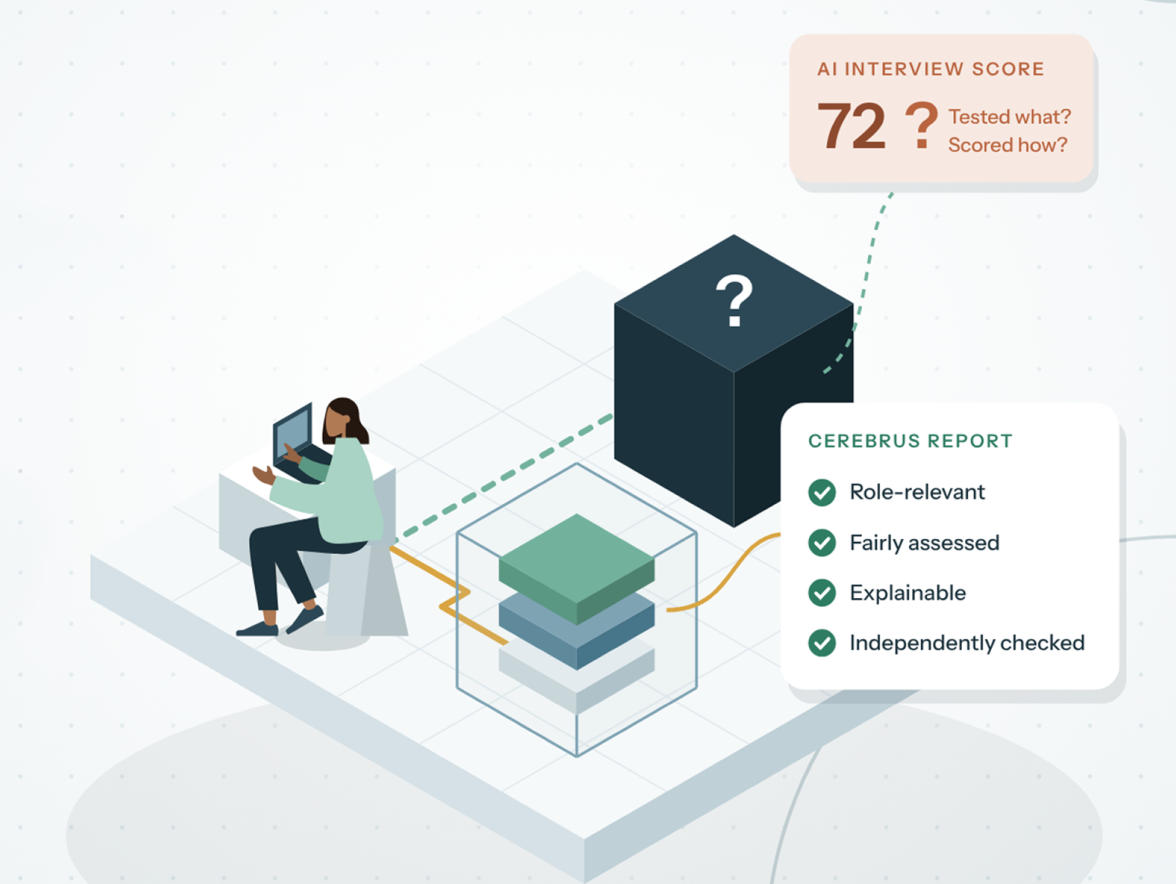
Hiring also needs to know whether the right capabilities were tested, whether answers were evaluated correctly, whether different candidates were assessed fairly, and whether the result can be explained.
The next stage of AI hiring therefore needs a different standard. Organizations need to ask whether the system can produce reliable evidence of a candidate’s competence.
AI interviews were built for efficiency, not accuracy
AI interviews have clear operational advantages. They reduce scheduling pressure, increase assessment capacity, and help companies process candidates faster. BSR’s review of AI in hiring identifies efficiency as one of the main reasons employers have adopted hiring algorithms, while also warning that these systems can reproduce existing bias.
Efficiency, however, does not prove assessment quality.
There is already evidence of what happens when automated hiring systems are trusted too quickly. A summary of the Harvard Business School and Accenture Hidden Workers study reports that 27 million skilled Americans were being screened out as “hidden workers,” while 88% of surveyed employers acknowledged that their screening systems caused them to miss qualified candidates.
The same principle applies to AI interviews. The number of interviews conducted, the sophistication of the AI, or the detail of the report does not establish that candidates were measured correctly.
AI interviews still need a clear way to measure competence
AI interviewers can conduct a natural conversation, understand responses, and generate relevant follow-up questions. These abilities make interviews easier to automate, but they do not define a reliable assessment.
The system still needs to know what the role requires, which capabilities should be tested, how deeply they should be examined, and what the candidate’s answers actually prove.
It also needs a consistent way to evaluate the evidence it collects.
This becomes more important when candidates receive different questions. Adaptation can make an interview more relevant, but the system must still account for differences in difficulty if the results are going to be compared.
The quality of an AI interview therefore cannot be judged mainly by the conversation it conducts.
The stronger test is whether the assessment underneath that conversation has a clear method for deciding what to measure, how to measure it, and how to turn the evidence into a reliable result.
Black-box scores create false confidence
AI assessments often end with a score, rating, or recommendation. These outputs make candidates easier to compare, but they can also create false confidence.
A score depends on several decisions. The system has to interpret answers, determine their importance, consider question difficulty, combine different pieces of evidence, and arrive at a final result.
If that process cannot be understood, the score becomes difficult to defend.
This concern is no longer theoretical. In August 2026, The Guardian reported on lawsuits involving automated employment systems where questions of secrecy, discrimination, and candidates’ ability to see or challenge automated evaluations were central to the disputes. The report also describes concerns around hiring systems operating as black boxes whose decisions are difficult for applicants to understand.
A numerical output is not automatically objective.
For a score to become useful evidence, organizations need to understand how it was produced and why the result deserves confidence.
The cost of an unexplained decision is no longer carried only by employers
As AI interviews have become a major part of hiring, candidates are being asked to place greater trust in systems they may not understand.
This matters because automated hiring is already widespread. The Guardian reported in August 2026, citing the World Economic Forum, that 90% of employers used some form of automation in hiring during the previous year. The same report describes concerns from candidates who may not know how they were evaluated or have a clear way to challenge the result.
Transparency therefore needs to become part of AI assessment.
Candidates should know when AI is involved and understand the basis of an important evaluation. When an outcome is disputed or the system is uncertain, there should be a route for human review.
This expectation is especially relevant as Gen Z enters more of the workforce having spent much of their lives interacting with automated systems.
Trust cannot come simply from the fact that an employer chose the technology. It has to come from an assessment process that candidates and employers can understand.
AI hiring needs clear assessment standards
Individual AI hiring systems cannot define assessment quality entirely on their own terms.
The industry needs common guidelines that establish what a trustworthy assessment system should be required to do.
Those guidelines should cover the basic conditions needed for reliable assessment. The system should control information that could wrongly influence evaluation. It should assess candidates in relation to the role. Different question paths should remain fairly comparable. Scoring should be understandable, and uncertain results should be identified.
There is already a wider call for this kind of accountability. Forbes Nonprofit Council has argued for stronger accountability around AI hiring, including regular audits, human oversight, job-related selection criteria, and greater transparency with applicants. BSR similarly recommends human oversight, regular review, and notification when candidates are being evaluated using AI.
Guidelines give employers a common basis for asking whether an assessment is trustworthy, rather than relying on each provider’s own definition of accuracy, fairness, or reliability.
Certification is how guidelines become proof
Guidelines establish what an AI assessment system should do. Certification provides a way to check whether a particular system actually meets those expectations.
Without independent evaluation, buyers largely depend on the company selling the product to establish that its system is accurate, reliable, fair, or explainable.
Independent scrutiny is already becoming part of the wider response to automated hiring. The Guardian reports that New York City requires annual bias audits for certain automated hiring systems and advance notice to candidates when covered technology is used. Earlier calls for accountability have also included regular internal or third-party audits of automated hiring tools.
Assessment certification needs to go further by examining whether the system measures candidates properly.
This is different from data-security certification. Protecting candidate information is important, but it has nothing to do with the quality of questions, evaluation of answers, or the final score.
AI hiring therefore needs standards and independent checks designed specifically around the quality of the assessment.
CCI makes the assessment accountable
Certification can verify whether an AI hiring system follows defined standards, but those standards need to be tied to a clear idea of what the system is actually measuring.
Broad labels such as strong, senior, or highly skilled are not enough because competence only becomes meaningful in relation to the work a candidate is expected to perform.
Contextual Competence Indexing, or CCI, provides that measurement basis by assessing competence against a defined role context. It considers what the role requires, what the candidate has actually done, and what their responses say about their ability to perform that work.
This also places responsibility on the assessment itself. A CCI-based system should be able to show that it tested relevant capabilities, accounted for differences in question difficulty, followed a defined scoring method, and identified cases where the available evidence was not strong enough for a confident result.
Certification can then evaluate whether the system follows these requirements consistently.
CCI therefore gives the assessment a clearer foundation, a role-specific, explainable method for measuring competence.
The next era of AI hiring will be built around proof, not automation
AI has already shown that interviews can be automated. The more important question now is whether automated assessment can be trusted.
The research around AI hiring shows why this question matters. AI can improve efficiency, but academic and industry reviews continue to identify risks involving bias, fairness, privacy, transparency, and accountability. The multidisciplinary review published in Human Relations describes both the potential benefits of AI hiring and its ability to conceal or reproduce inequality when the systems underneath it are not properly understood.
Organizations therefore need to know whether the system measured capabilities relevant to the role, assessed candidates fairly, explained its scoring, identified uncertainty, and survived independent examination.
This requires three connected elements.
Guidelines define what trustworthy AI assessment should require. Certification provides independent evidence that a system meets those requirements. CCI provides a framework for measuring competence in relation to the work a candidate is being considered for.
The future of AI hiring should be judged by the quality of the evidence it produces, not simply by the number of interviews it can automate.
